Project dive · MomSpace
MomSpace
This case study is being written. The content below is intentionally marked as to be added.
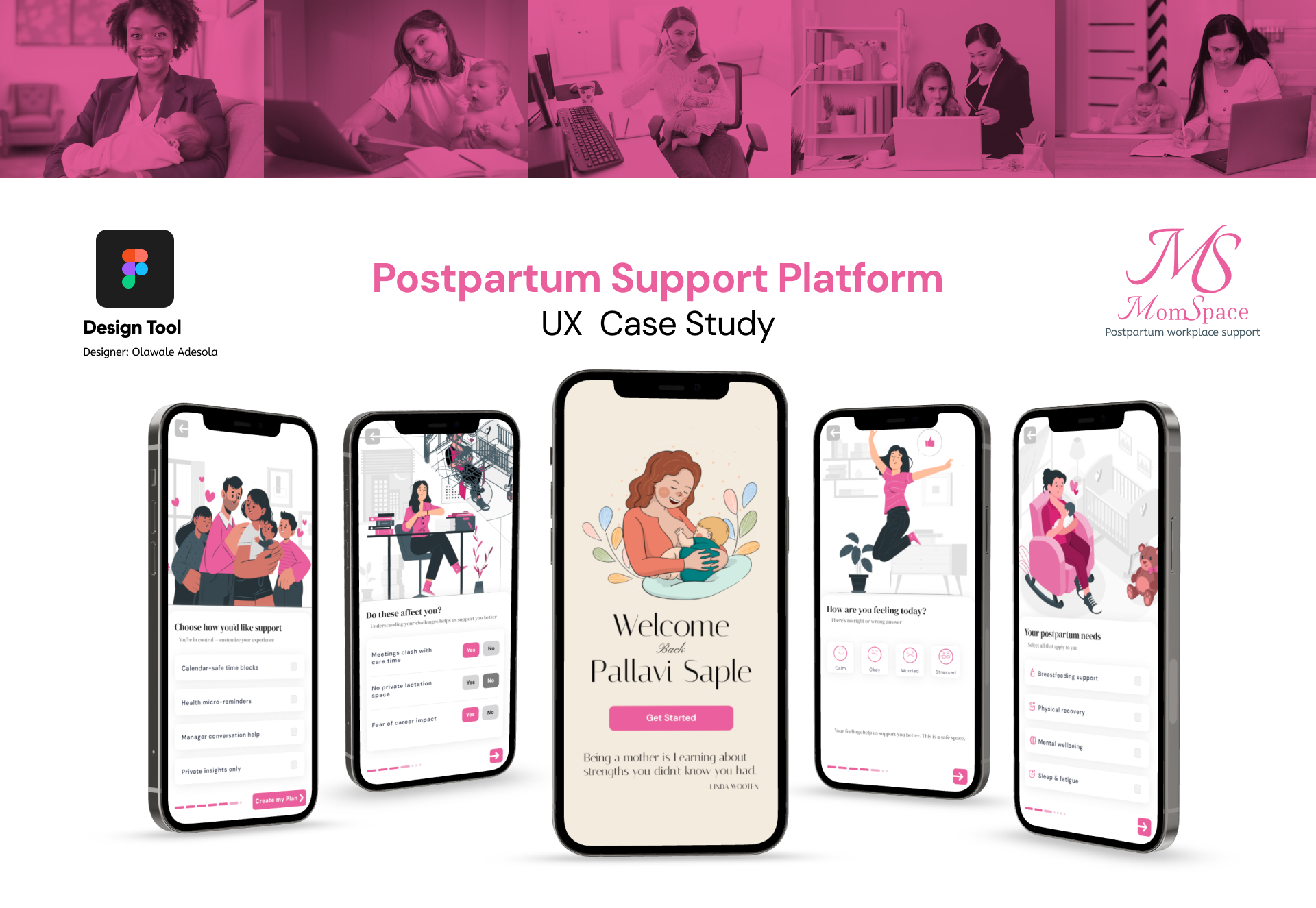
New moms in India lack practical, private, and ongoing postpartum workplace support that fits into their everyday workday.
- Domain
- SaaS
- My role
- Product Designer — research, flows, UI
- SOLO
- Pallavi Saple
- Duration
- 1 month
- Platform
- Mobile
- Status
- In progress
Overview
The project at a glance
Product Designer — research, flows, UI
Pallavi Saple
1 month
SaaS · Mobile
Mobile
In progress
The challenge
New mothers returning to work in Indian SaaS companies need better support to manage postpartum health and caregiving alongside their work responsibilities.
Business context
This project explores that opportunity through a privacy-first, employee-focused experience. Business outcomes such as retention, engagement or reduced stress would need to be validated through further research and testing.
User context
The problem appears throughout the transition between home, commute and workplace. A new mom may start her day managing the baby and her own recovery, then move into meetings, focused work, breastfeeding or pumping breaks, and caregiving responsibilities. The difficult part is that these things don't happen in separate boxes. They overlap during the same working day. That's why I chose to explore a discreet, wearable experience rather than making the user constantly open another workplace application.
Problem framing
From the requirement to the real problem
- 01 · Initial request
New mothers returning to work in Indian SaaS companies need better support to manage postpartum health and caregiving alongside their work responsibilities.
- 02 · Investigation
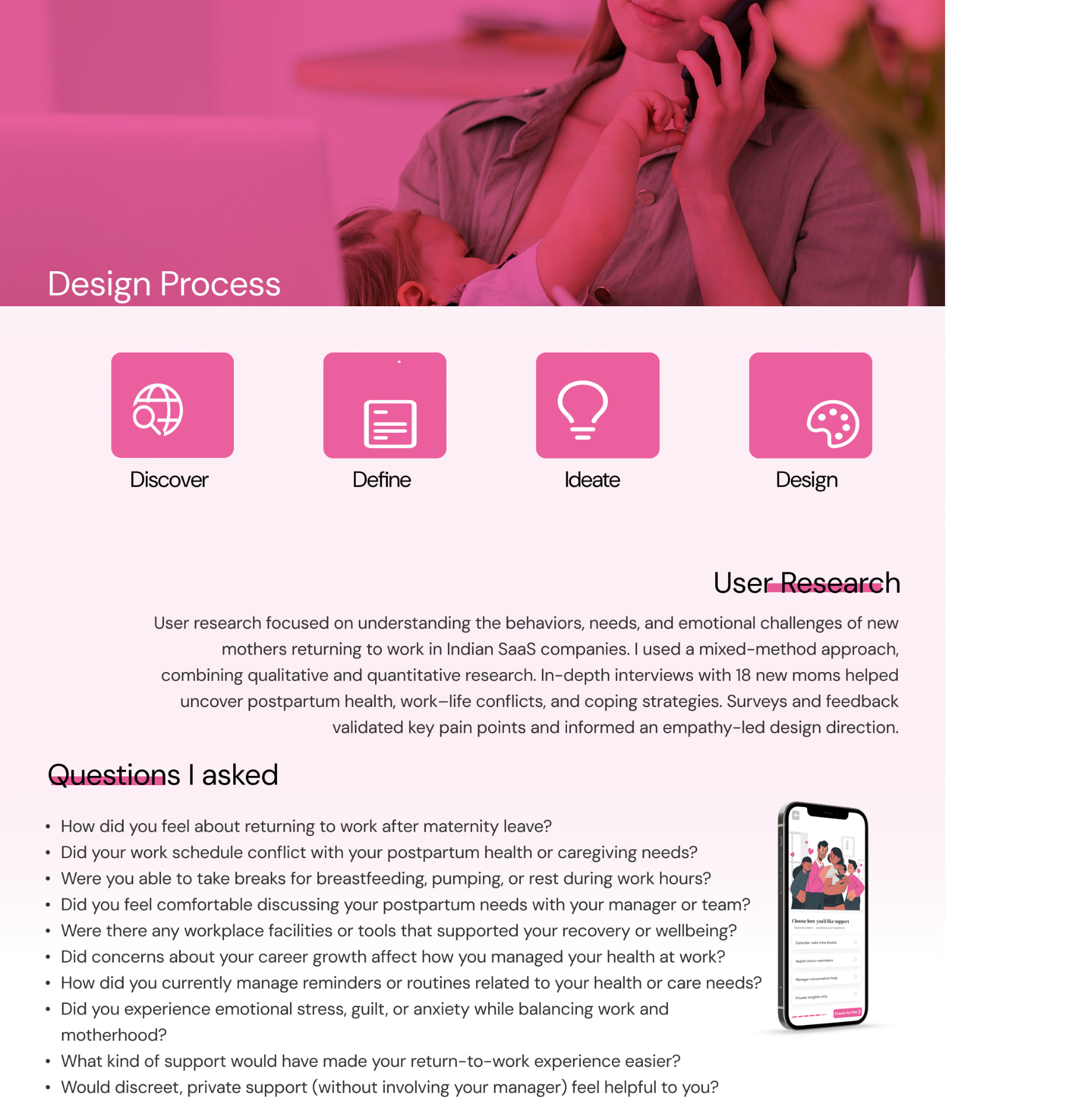
Through conversations with 18 participants, I explored the everyday challenges new moms experience when returning to work—particularly around breastfeeding, physical recovery, mental wellbeing, work schedules, and concerns about career impact. The investigation shifted my thinking from “Do companies provide maternity benefits?” to “What happens during the actual working day when a mother's health and work responsibilities collide?”
- 03 · Underlying user problem
New moms in India lack practical, private, and ongoing postpartum workplace support that fits into their everyday workday.
- 04 · Product opportunity
Create a discreet, supportive workplace experience that helps returning mothers manage care needs, wellbeing, and work responsibilities with greater confidence—without making them feel monitored or adding another task to their day.
How might we make returning to work easier for new moms by giving them the right support for their health, baby, and workday—without adding more stress?
Evidence
How I understood the problem
I started with a personal concern around returning to work after becoming a new mom. Instead of assuming what other mothers needed, I wanted to understand where the real difficulties were—especially around health, breastfeeding, mental wellbeing, work schedules and career concerns. I used a mix of qualitative and quantitative research, including conversations with new mothers and short survey-style questions. The research helped me look beyond the obvious problem of “work-life balance” and understand the smaller moments that make returning to work difficult.
Qualitative interviews
I spoke with 18 people to understand their experiences of returning to work after maternity leave, the challenges they faced during their workday, and how they currently managed those situations.
Quantitative research
I used short survey questions to identify whether common challenges were recurring across participants—for example, meeting conflicts, breastfeeding/pumping needs, emotional stress and concerns about career impact.
What has already been tried here?
Companies already have maternity policies, leave and employee wellbeing programs. But having a policy doesn't necessarily solve the small challenges a new mom faces during an actual working day. The gap I found interesting was between formal workplace support and everyday support. That became an important direction for my project: How can we make support available at the moment a mom actually needs it?
Where does this live in the user's day?
The problem appears throughout the transition between home, commute and workplace. A new mom may start her day managing the baby and her own recovery, then move into meetings, focused work, breastfeeding or pumping breaks, and caregiving responsibilities. The difficult part is that these things don't happen in separate boxes. They overlap during the same working day. That's why I chose to explore a discreet, wearable experience rather than making the user constantly open another workplace application.
What forces constrain the system?
Several things are competing for the user's limited time and attention:
- Work meetings and deadlines
- Breastfeeding or pumping schedules
- Physical recovery
- Sleep and fatigue
- Baby-care responsibilities
- Mental and emotional wellbeing
- Fear of affecting career growth
- Limited time to ask for help
The biggest constraint is attention. A new mom doesn't need another system that demands more time from her. The support needs to fit into the moments she already has.
How do the parts react together?
This is where I found the problem became more emotional. When work pressure, health needs and caregiving responsibilities collide, one problem can trigger another. For example: Meeting conflict → missed care break → physical discomfort → stress → reduced focus → more pressure. At the same time, concerns about being perceived as less committed can make someone hesitant to ask for support. So the product needed to feel supportive rather than supervisory. That is also why privacy became an important part of the experience.
How does the behaviour actually grow?
I looked at the small behaviours that repeat throughout the day. New moms may create their own reminders, adjust their schedules, postpone breaks, work around meetings or simply try to remember everything themselves. Over time, these workarounds can become a routine. My design opportunity was therefore not to create another complicated health tracker, but to introduce small, timely interventions—gentle reminders, protected time, emotional check-ins and micro-wellness moments. The goal is to help the user build a healthier routine without making her feel like she has another task to complete.
What can be measured and defended?
For the first version of the case study, I would keep the metrics honest and separate research evidence from future success metrics.
Research measures
- 18 participants interviewed
- Recurring workplace and postpartum challenges identified
- Qualitative themes from interviews
- Survey responses used to validate common pain points
Product metrics to validate later
- Reduction in missed or postponed health breaks
- Increase in users taking planned support breaks
- Daily engagement with support reminders
- Self-reported stress before vs. after using the product
- Confidence in managing work and postpartum needs
- Retention/continued use of the support plan
I would not claim improvement percentages yet, because those would need usability testing or a live product to validate.
User insights
Observation → insight → implication
- Observation
New moms often have to fit breastfeeding, recovery, rest, and caregiving around meetings, deadlines, and fixed work schedules. The 18 interviews were used to understand these everyday difficulties and how participants currently manage them.
- Insight
The challenge isn't only a lack of workplace benefits—it is the difficulty of managing everyday health and caregiving needs without disrupting work.
- Design implication
Design support that fits into the user's existing workday rather than asking her to manage another complex app. Use gentle reminders, protected time, quick emotional check-ins, and discreet smartwatch interactions.
User journey
Where the experience breaks down
Journey stages are placeholders until the documented journey is added.
- 1DiscoverUser action
Realises that returning to work will mean managing postpartum recovery, baby-care needs and work responsibilities at the same time.
User thought“How am I going to manage my health and my baby while keeping up with work?”
Pain pointExisting workplace support may address maternity leave, but the everyday challenges of returning to work are harder to manage.
EmotionUncertain · Anxious
OpportunityMake practical postpartum support easy to discover and understand before the user returns to work.
- 2StartUser action
Shares her postpartum needs, work challenges and the type of support she would like.
User thought“I want support, but I also want to stay in control of my personal information.”
Pain pointHealth and wellbeing information is personal. The user may be cautious about sharing it with managers or colleagues.
EmotionCautious · Vulnerable
OpportunityBuild trust from the beginning through privacy, consent and user-controlled support options.
- 3UseUser action
Uses the smartwatch throughout the workday for gentle reminders, protected time, wellbeing moments and emotional check-ins.
User thought“I need a little help remembering myself while I’m managing everything else.”
Pain pointMeetings, deadlines and caregiving responsibilities can compete with health needs, making it easy to postpone breaks or self-care.
EmotionStretched · Overwhelmed
OpportunityProvide small, timely and glanceable support without requiring the user to stop work and open another app.
- 4ReturnUser action
Reviews her support plan and adjusts it as her routine, health and work needs change.
User thought“What worked for me last week may not work for me today.”
Pain pointPostpartum needs change over time, so a fixed set of reminders may become irrelevant or burdensome.
EmotionMore confident · Supported
OpportunityLet the experience adapt to the user's changing needs, with the ability to pause, change or personalise support.
Product opportunity
Where value, viability and feasibility meet
New moms in India lack practical, private, and ongoing postpartum workplace support that fits into their everyday workday.
Employers need better ways to support new mothers through the return-to-work period, helping improve employee wellbeing, engagement, and retention while strengthening their workplace support and inclusion efforts.
Several things are competing for the user's limited time and attention:
Create a discreet, supportive workplace experience that helps returning mothers manage care needs, wellbeing, and work responsibilities with greater confidence—without making them feel monitored or adding another task to their day.
Process
Directions considered, flows and early exploration
Concept A
- What it solves
- Brings postpartum support, reminders, wellbeing check-ins and workplace resources into one dedicated app.
- Strength
- Can provide a complete experience with more space for detailed information and personalization.
- Limitation
- The user has to intentionally open another app during an already busy workday.
- Effort / complexity
- Medium — requires a full mobile product and integration with workplace information.
- User value
- Good for planning and reviewing support, but less useful for quick, in-the-moment needs.
Concept B
- What it solves
- Helps users identify meeting conflicts and create protected time for breastfeeding, pumping, rest or wellbeing.
- Strength
- Connects support directly to the user's existing work schedule instead of creating a separate routine.
- Limitation
- It mainly addresses time and scheduling, while postpartum wellbeing is broader than calendar management.
- Effort / complexity
- Medium–High — calendar integration and workplace permissions introduce additional complexity.
- User value
- High for reducing schedule conflicts, but it doesn't fully address emotional or physical wellbeing.
Concept C
- What it solves
- Provides small, timely moments of support—such as pumping reminders, protected time, emotional check-ins, hydration and mindfulness—without requiring the user to open an app.
- Strength
- The support is glanceable, discreet and available during the workday.
- Limitation
- A smartwatch has limited screen space, so the experience must stay focused and avoid complex tasks.
- Effort / complexity
- Medium — requires careful small-screen interaction design and a companion mobile experience for deeper settings.
- User value
- High for quick, private support when the user has limited time and attention.
Design decisionSupport her day, don't add to it.
Final experience
The solution
Design decisions
Decisions, not just screens
Design decisions
- ProblemNew moms often have to fit breastfeeding, recovery, rest, and caregiving around meetings, deadlines, and fixed work schedules. The 18 interviews were used to understand these everyday difficulties and how participants currently manage them.
- Options considered
- A. Dedicated workplace app — Provide all support through a mobile app.
- B. Calendar-based support — Focus mainly on protecting care and wellness time around meetings.
- C. Smartwatch-first support — Provide small, timely reminders and check-ins directly from the user's wrist.
- Trade-offA mobile app could offer more information and functionality, while calendar integration could directly address scheduling conflicts. However, both require the user to actively engage with a digital system. A smartwatch has less space and interaction capability, but it can provide support with much less effort.
- DecisionDesign support that fits into the user's existing workday rather than asking her to manage another complex app. Use gentle reminders, protected time, quick emotional check-ins, and discreet smartwatch interactions.
- WhyThe research pointed toward a need for low-effort, everyday support, not another system that adds to the user's workload. The smartwatch allows important moments of support to appear without requiring the user to stop, open an app, or explain her situation to someone else.
- Design principleSupport her day, don't add to it.
- Expected outcomeHelp new moms manage important health and care moments during the workday with less effort and greater confidence, while keeping the experience private and user-controlled.
Testing & validation
What was tested, and what changed
- Prototype
- Test
- Observe
- Learn
- Iterate
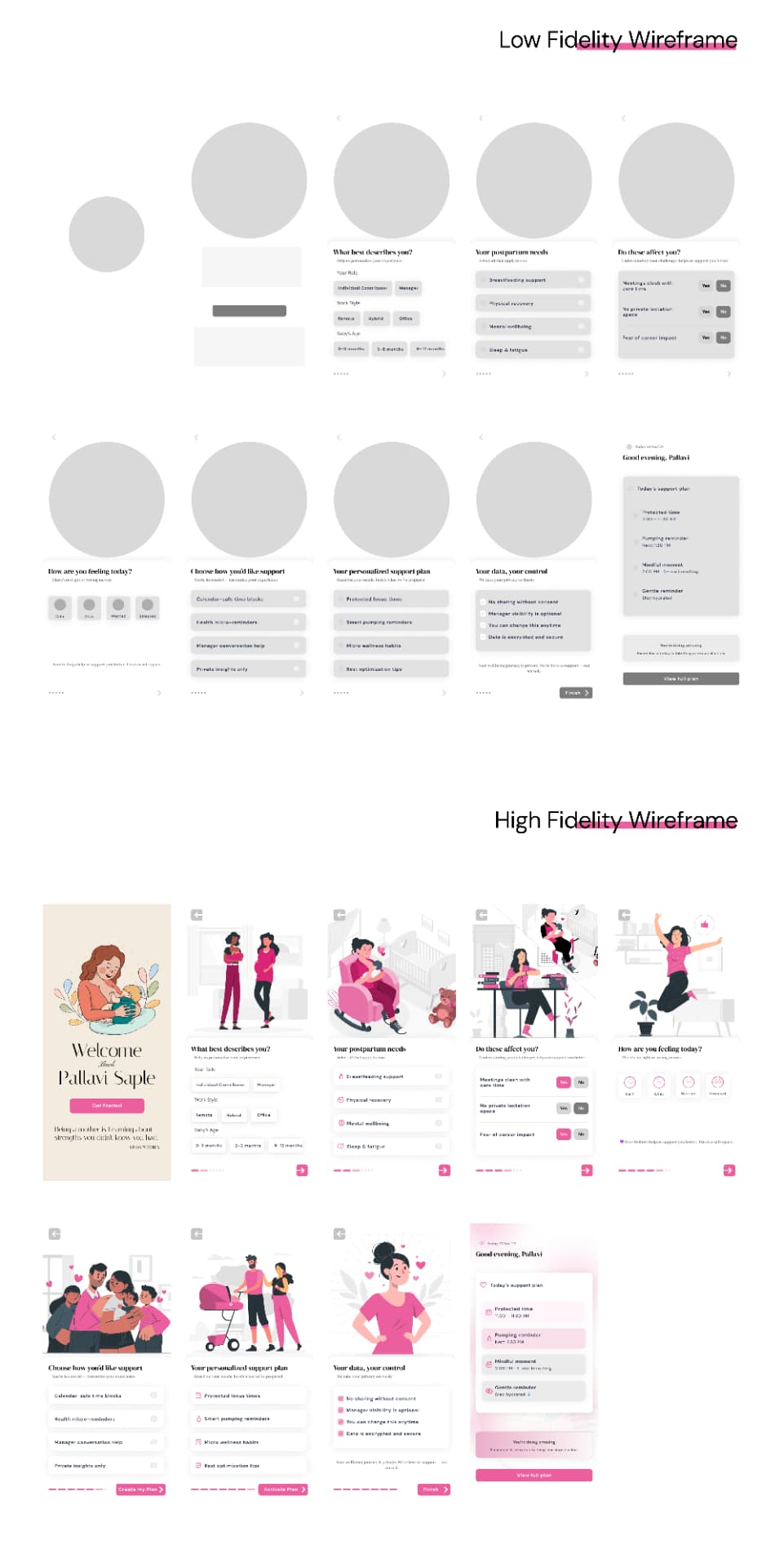
The core onboarding and support journey, including needs selection, workplace challenges, emotional check-in, support preferences, personalized plan and privacy controls.
New mothers / returning working mothers, particularly those with experience balancing postpartum needs with workplace responsibilities.
- To be validated through usability testing.
- The current prototype establishes the intended experience, but I have not documented enough test evidence to claim a confirmed usability outcome.
The current design hypothesis is that new moms need small, timely and private support, rather than another complex workplace application. This still needs to be validated through direct prototype testing.
I would specifically look for changes around: Onboarding length Clarity of support options Privacy messaging Reminder frequency Smartwatch interaction Personalization controls
Quantitative impact was not measured.
Before → after
- New moms have to manage postpartum needs around meetings, deadlines and caregiving responsibilities.
- Support can feel disconnected from the actual working day.
- Personal wellbeing needs may be difficult to manage privately at work.
- Existing support can require the user to actively seek it out.
- Gentle, timely support during the workday.
- Protected time for important care and wellbeing moments.
- Quick emotional check-ins without requiring a lengthy interaction.
- Privacy-first controls that keep the user in control.
- Smartwatch-first interactions that make support available without adding another task.
Outcome & impact
What changed — reported honestly
Create a discreet, supportive workplace experience that helps returning mothers manage care needs, wellbeing, and work responsibilities with greater confidence—without making them feel monitored or adding another task to their day.
Qualitative — intended outcome.
Intended business impact: Help employers provide more practical support to returning mothers beyond maternity leave policies. Support employee wellbeing and confidence during the return-to-work transition. Create an opportunity for employers to strengthen their maternal wellbeing and employee-support programs. Potentially support longer-term retention and engagement of returning mothers.
Solo Project - For this concept, the strongest delivery outcome is the product-design work itself: Translated a broad workplace wellbeing problem into a focused product opportunity. Explored multiple solution directions before selecting a smartwatch-first approach.
Reflection
What I learned
Starting with a personal experience helped me stay close to the real problem instead of jumping straight into UI. Talking to users and looking at the return-to-work journey helped me see that the challenge is not just about maternity benefits—it is about the small, everyday moments where health, caregiving and work collide. The smartwatch direction also worked well because it keeps the support quick, discreet and easy to access during a busy workday.
If I were doing this again, I would spend more time on validation before moving into the final UI. I would test the prototype with more returning mothers and compare different approaches to reminders, privacy and manager visibility. I would also narrow the first version further. There are many possible postpartum needs, but solving one high-impact moment really well would make the product more focused.
“Does this support the user, or does it create one more thing for them to manage?”
If I had more time — next I would explore…
- — Complete case-study validation with more returning working mothers.
- — Test the smartwatch interactions in realistic workday situations.
- — Validate whether reminders feel helpful or intrusive.
- — Explore different levels of manager visibility and privacy control.
- — Define measurable outcomes around wellbeing, support usage and confidence.
- — Test whether the experience actually reduces the effort of managing postpartum needs during work.
Team & collaboration
- My contribution
- Product Designer — research, flows, UI
- Team contribution
- Solo project — I owned the end-to-end design process, from research and problem framing to prototype. I used feedback from users and peers to challenge and refine the direction.
In short
The case study in four lines
- The problem
- New moms in India lack practical, private, and ongoing postpartum workplace support that fits into their everyday workday.
- The decision
- Choose a smartwatch-first, privacy-led approach that delivers small, timely support without adding another complex app to the user's day.
- The outcome
- Create a discreet, supportive workplace experience that helps returning mothers manage care needs, wellbeing, and work responsibilities with greater confidence—without making them feel monitored or adding another task to their day.
- The learning
- Good product design isn't about adding more support—it is about making the right support available at the right moment, without creating more work for the user.