Project dive · MockOraa
Turning interview practice into a loop people return to
A 0→1 product where the hardest design problem was motivation, not features.
People preparing for interviews practise inconsistently and cannot tell whether they are actually improving.
- Domain
- Interview practice
- My role
- Product Designer — concept, flows, usability
- Team
- Raviteja Mokkarala, Pallavi Saple, Mounesh Pattar, Navyashree L S, Snehal Gharave, Vasini Singh, Praveen Prabhakaran
- Duration
- 3 months
- Platform
- Consumer product
- Status
- Design Complete
Overview
The project at a glance
Product Designer — concept, flows, usability
Raviteja Mokkarala, Pallavi Saple, Mounesh Pattar, Navyashree L S, Snehal Gharave, Vasini Singh, Praveen Prabhakaran
3 months
Interview practice · Consumer product
Consumer product
0→1 product · Behaviour design · Confidence metrics
The challenge
Preparation tools are good at generating questions and poor at sustaining practice. People start, feel exposed, and stop.
Business context
MockOraa blends AI + psychology to create a safe space to practice, reflect, and grow through empathy-first feedback.
User context
Practice happens in short, private, often late-night windows. Sessions had to be startable in under a minute and finishable in ten.
Problem framing
From the requirement to the real problem
- 01 · Initial request
Preparation tools are good at generating questions and poor at sustaining practice. People start, feel exposed, and stop.
- 02 · Investigation
Interviews are a repeated-performance skill, so a product that measures a single attempt measures the wrong thing.
- 03 · Underlying user problem
People preparing for interviews practise inconsistently and cannot tell whether they are actually improving.
- 04 · Product opportunity
A practice loop designed for repeat sessions, with visible progress signals instead of one-off scores.
The design brief became: make the second session more likely than the first.
Evidence
How I understood the problem
Research methods are listed only where documented. The six-lens framework below is how the problem was interrogated.
[ADD RESEARCH EVIDENCE]
[ADD RESEARCH EVIDENCE]
[ADD RESEARCH EVIDENCE]
What has already been tried here?
Existing tools lean on question banks and scoring. Both are easy to build and neither addresses the reason people quit after one attempt.
Where does this live in the user's day?
Practice happens in short, private, often late-night windows. Sessions had to be startable in under a minute and finishable in ten.
What forces constrain the system?
Self-recorded practice is emotionally costly. Every additional setup step multiplies the chance of abandonment.
How do the parts react together?
Feedback and confidence interact: harsh feedback immediately after a weak attempt suppresses return visits. Feedback framing was designed alongside the scoring model.
How does the behaviour actually grow?
Improvement compounds through repetition. The interface foregrounds streaks of practice and delta-over-time rather than absolute quality.
What can be measured and defended?
Session completion, repeat-practice rate and self-reported confidence were chosen because each can be measured directly and defended in an interview.
User insights
Observation → insight → implication
- Observation
Abandonment clustered before the first answer, not during it.
- Insight
[DETAIL TO VERIFY]
- Design implication
Collapsed setup into a single tap-to-start session card.
- Observation
Participants reacted defensively to absolute scores in early concept tests.
- Insight
[DETAIL TO VERIFY]
- Design implication
Replaced a single quality score with a progress delta across sessions.
- Observation
Users who finished a session had no clear next action and did not return.
- Insight
[DETAIL TO VERIFY]
- Design implication
Every session ends by proposing one specific, smaller next session.
- Observation
Exposure anxiety was the most cited reason for not practising.
- Insight
[DETAIL TO VERIFY]
- Design implication
No sharing, no leaderboard, explicit local-first framing.
User journey
Where the experience breaks down
Journey stages are placeholders until the documented journey is added.
- 1DiscoverUser action
[DETAIL TO VERIFY]
User thought[DETAIL TO VERIFY]
Pain point[DETAIL TO VERIFY]
Emotion[DETAIL TO VERIFY]
Opportunity[DETAIL TO VERIFY]
- 2StartUser action
[DETAIL TO VERIFY]
User thought[DETAIL TO VERIFY]
Pain point[DETAIL TO VERIFY]
Emotion[DETAIL TO VERIFY]
Opportunity[DETAIL TO VERIFY]
- 3UseUser action
[DETAIL TO VERIFY]
User thought[DETAIL TO VERIFY]
Pain point[DETAIL TO VERIFY]
Emotion[DETAIL TO VERIFY]
Opportunity[DETAIL TO VERIFY]
- 4ReturnUser action
[DETAIL TO VERIFY]
User thought[DETAIL TO VERIFY]
Pain point[DETAIL TO VERIFY]
Emotion[DETAIL TO VERIFY]
Opportunity[DETAIL TO VERIFY]
Product opportunity
Where value, viability and feasibility meet
People preparing for interviews practise inconsistently and cannot tell whether they are actually improving.
[ADD BUSINESS NEED]
Self-recorded practice is emotionally costly. Every additional setup step multiplies the chance of abandonment.
A practice loop designed for repeat sessions, with visible progress signals instead of one-off scores.
Process
Directions considered, flows and early exploration
Concept A
- What it solves
- [DETAIL TO VERIFY]
- Strength
- [DETAIL TO VERIFY]
- Limitation
- [DETAIL TO VERIFY]
- Effort / complexity
- [DETAIL TO VERIFY]
- User value
- [DETAIL TO VERIFY]
Concept B
- What it solves
- [DETAIL TO VERIFY]
- Strength
- [DETAIL TO VERIFY]
- Limitation
- [DETAIL TO VERIFY]
- Effort / complexity
- [DETAIL TO VERIFY]
- User value
- [DETAIL TO VERIFY]
Concept C
- What it solves
- [DETAIL TO VERIFY]
- Strength
- [DETAIL TO VERIFY]
- Limitation
- [DETAIL TO VERIFY]
- Effort / complexity
- [DETAIL TO VERIFY]
- User value
- [DETAIL TO VERIFY]
[ADD DESIGN DECISION]
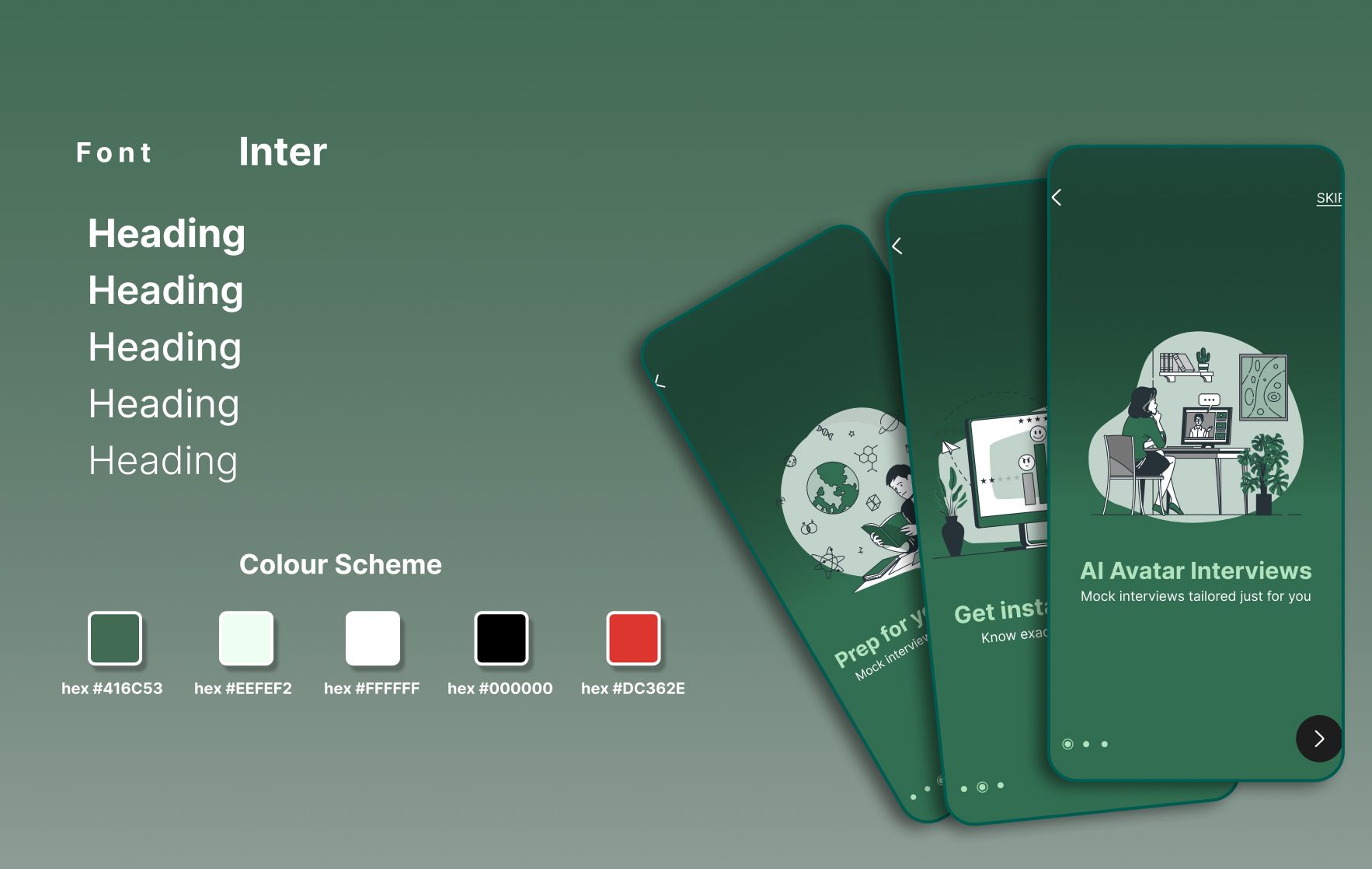
Design Process /Style Guide
[ADD DIAGRAM / WIREFRAME]UI Design — what I was testing here
[ADD DIAGRAM / WIREFRAME]Final experience
The solution
Design decisions
Decisions, not just screens
Optimise the start, not the score
- Problem
Abandonment clustered before the first answer, not during it.
- Options considered
[DETAIL TO VERIFY]
- Trade-off
[DETAIL TO VERIFY]
- Decision
Collapsed setup into a single tap-to-start session card.
- Why
[ADD DECISION RATIONALE]
- Expected outcome
[ADD TESTING RESULT]
Show change, not judgement
- Problem
Participants reacted defensively to absolute scores in early concept tests.
- Options considered
[DETAIL TO VERIFY]
- Trade-off
[DETAIL TO VERIFY]
- Decision
Replaced a single quality score with a progress delta across sessions.
- Why
[ADD DECISION RATIONALE]
- Expected outcome
[ADD TESTING RESULT]
Make the second session obvious
- Problem
Users who finished a session had no clear next action and did not return.
- Options considered
[DETAIL TO VERIFY]
- Trade-off
[DETAIL TO VERIFY]
- Decision
Every session ends by proposing one specific, smaller next session.
- Why
[ADD DECISION RATIONALE]
- Expected outcome
[ADD TESTING RESULT]
Private by default
- Problem
Exposure anxiety was the most cited reason for not practising.
- Options considered
[DETAIL TO VERIFY]
- Trade-off
[DETAIL TO VERIFY]
- Decision
No sharing, no leaderboard, explicit local-first framing.
- Why
[ADD DECISION RATIONALE]
- Expected outcome
[ADD TESTING RESULT]
Testing & validation
What was tested, and what changed
- Prototype
- Test
- Observe
- Learn
- Iterate
[ADD TESTING RESULT]
[ADD TESTING RESULT]
[ADD TESTING RESULT]
[ADD TESTING RESULT]
[ADD TESTING RESULT]
Quantitative impact was not measured.
Before → after
- Multi-step setup before the first question
- A single absolute score per attempt
- No defined next action after a session
- Practice framed as performance
- One-tap session start
- Progress delta across sessions
- Each session ends by proposing the next one
- Practice framed as private rehearsal
Outcome & impact
What changed — reported honestly
A practice loop designed for repeat sessions, with visible progress signals instead of one-off scores.
Qualitative — intended outcome.
[ADD BUSINESS IMPACT]
[DETAIL TO VERIFY]
Metric to be validated
Usability sample
Metric to be validated
Task completion
Metric to be validated
Confidence score
Reflection
What I learned
[DETAIL TO VERIFY]
[DETAIL TO VERIFY]
For skill products, the design target is the return visit. Anything that makes the first session impressive but the second session unlikely is a net loss.
If I had more time — next I would explore…
- — Measure session completion and 7-day repeat rate
- — Run a documented usability study with a stated sample size
- — Validate the confidence instrument against a standard scale
Team & collaboration
- My contribution
- Product Designer — concept, flows, usability
- Team contribution
- [DETAIL TO VERIFY]
In short
The case study in four lines
- The problem
- People preparing for interviews practise inconsistently and cannot tell whether they are actually improving.
- The decision
- Optimise the start, not the score
- The outcome
- A practice loop designed for repeat sessions, with visible progress signals instead of one-off scores.
- The learning
- For skill products, the design target is the return visit. Anything that makes the first session impressive but the second session unlikely is a net loss.